This post unites two previous posts both dealing with online reviews. One focuses on speaking practice, the second one on writing training.
Reading&Speaking: Online Reviews in Your ESL Lesson
When we think about reading, we picture books, newspapers or magazines. However, your students probably read shorter texts on a daily basis — texts geared more towards consumption than entertainment or current affairs, and often densely packed with information. Let me give you a simple example of how to train students to find and read this type of text in real life, along with some tasks you can adapt for your lesson, aimed at improving reading for detail. Let your students use their usual apps and make them find reviews about every-day products.
Where to Find Authentic Online Reviews
Choose an object your students might use on a daily basis — my pick is a coffee machine.
As a lead-in, ask your students what matters to them in a coffee machine: colour, price, number of cups, brand, and so on. Then ask them to go to amazon.co.uk and type the chosen product name into the search field (here is my search). They can do this in pairs, on their mobile phones. The task is to choose three favourites from the first page and give reasons for their choice — for example, price range or colour.
Next, ask your students to look at these three products in more detail (by clicking on them), reading the descriptions and some of the reviews. They can analyse them in pairs and decide which one they would buy, and why.
One pair could then present their decision to the class, explaining the reasons behind their choice.
Follow-Up Activities
Finally, you might want to ask your students:
- To repeat the task for the same product, but from a particular perspective — for example, which product would a university student, an Italian designer, a bank clerk, or a primary-school teacher buy, and why? Which of these would make the perfect present for a friend or relative?
- To repeat the task with a different product: anything from mobile phones to English coursebooks.
- To browse other websites — draw on your students' own interests, and consider any shopping sites or portals that offer product comparisons.
- To make a decision about a service: a mobile phone plan, a trip, an English course abroad, and so on.
The important thing is that your students practise reading texts packed with detail, and get used to making decisions based on the factors that matter most to them.
Writing: How to Write an Online Review
Introduction: What Is a Review?
The review is one of the genres students are expected to write from B2 level upwards. However, since the typical structures involved — would for recommendations, passive sentences, strong adjectives — are taught at B1 level, you can begin working on reviews from this level onwards.
By the book, a review is expected to give details about the product or service itself, and about where and when the writer experienced it, before expressing an opinion and offering a recommendation to other users or customers.
Yet if you search for your favourite local restaurant online and read the reviews, you'll often find short, dry "reviews" where the star rating counts for far more than the written description. It seems our online manners are still evolving — and will take time and patience to catch up.
So let me suggest an activity to help your students practise writing a genuine review, in a genuine context.
Procedure: How to Write a Review
Nowadays, you can leave a review about almost anything: alongside restaurants, pubs and hotels, you can share your opinion of your plumber, your language teacher, or the taxi firm you usually call for a ride. So let's start there.
Search online for some of your favourite restaurants and find reviews of them written in English. Ask your students to do the same, and to begin by reading around ten existing reviews. List on the whiteboard what customers liked and disliked about each place. For example:
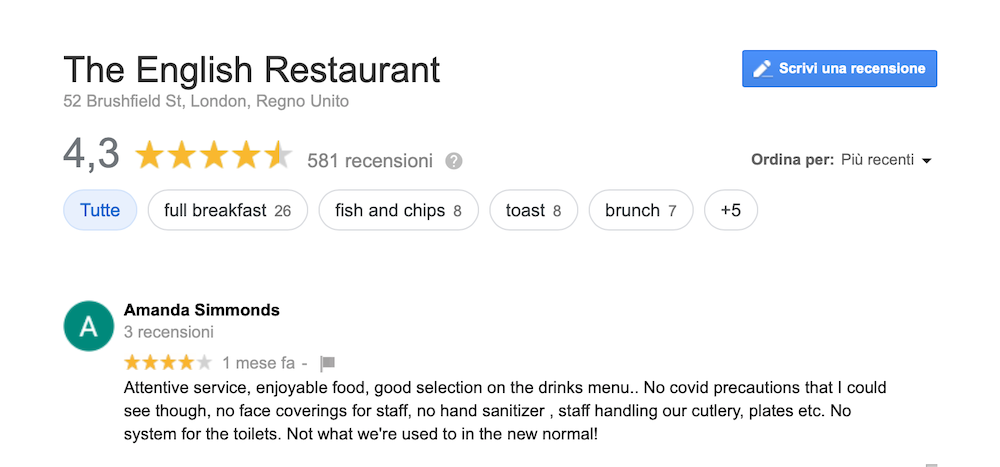
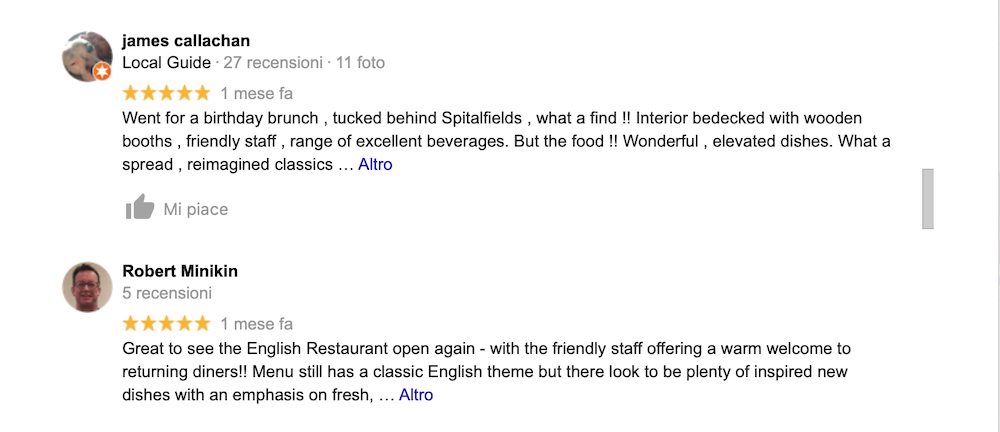
Liked: service, food, choice of drinks, interior, opening hours, welcoming returning customers, menu, new dishes, fresh ingredients
Disliked: no pandemic precautions, the toilets
Then analyse the style and language of these reviews:
- Do they use complete sentences?
- Do they use adjectives? How many, and of what type?
- Do they use passive sentences?
- And so on.
Ask students to complete any incomplete sentences and highlight all the adjectives they can find.
Ask students to decide which reviewer writes about: (a) positive aspects; (b) negative aspects; (c) details of their last visit; (d) recommendations. Give feedback, then work with the students to put these points into a logical order (c – a – b – d), and make clear that a good review should cover all of them.
Now decide, together with the students, what you'll write about — why not your own school? Look it up online and see if you can find any existing reviews in English. Then give students ten minutes to write their own review.
Decide in advance whether you want them to publish their reviews (in which case, they can write directly into the review field on Google) or keep them private (in which case, they can write them in an email or in their notebook). Whichever you choose, correct their mistakes — through peer correction first, followed by your own feedback where possible — covering both language and content.
Use these exercises to train your students' critical thinking further: