After more than ten years of classroom teaching (mostly to adults, but also to young learners), I was pretty fed up with coursebooks. I started teaching English to children at home, in the room I use for my home nursery in the mornings. In addition to my two boys' groups, I managed to set up a mini-group with eight- and nine-year-old girls, and could finally start a very exciting type of course: one based on projects. Let me explain what that means.
Why Projects?
First, a short explanation of why I wanted to try this type of course. For years, as a didactic coordinator, I was asked to write "standardised long-term plans" for our courses. We had seven adult levels, but nine young-learner ones! Writing a long-term plan practically meant choosing a book that covered most of our centralised syllabus for each level (the school I worked for was a franchise) and inserting the missing syllabus points at the end of one chapter or another — plus adding revision and test lessons, all within a given number of lessons.
So, very early on, I had to acknowledge a few things:
- For young learners, there is no internationally recognised, standardised syllabus. Looking at the adult levels, young learners — up to roughly the age of eight — are effectively expected to learn the vocabulary and grammar points of the A1 level (CEFR).
- There are internationally recognised exams (Cambridge YLE or Trinity GESE), but these are only available for children between seven and twelve.
- Whether the first point causes the second, or the other way round, is a mystery to me. I went through the English books available for years one to three of the Italian school system and, to my surprise, they all cover the same grammar and vocabulary points: colours, numbers, the alphabet, the -ing form (often without linking it to the present continuous), some adjectives, classroom and everyday objects, animals, singular and plural forms, demonstrative pronouns this/that, possessive adjectives (my, your, etc., often only in the singular form) — and little else. I remember mothers complaining that their children learned the numbers and colours in year one, then the numbers and colours again in year two, and then, guess what, the colours once more. No real challenge, just a lot of repetition. But what can a child actually do with all this, say, on a holiday in London?
- With adults, we have a fairly clear idea of what they should be able to do in everyday life (as a tourist, or emailing native and non-native colleagues in English, for example). For children, there is no equivalent list of what they should be able to do at each age. Such a list would need to take toys into account, and include skills like understanding instructions for a game, or — thinking of international school trips — asking for help or buying a present for a younger sibling. As for TV culture, Peppa Pig is a firm favourite up to about the age of four, which suggests another set of syllabus points: understanding short episodes of popular cartoons (Peppa Pig conveniently offers five-minute episodes). There are also plenty of lists of age-appropriate toys, so children aged one to three might need language for playing with Duplo, then LEGO, then dressing-up in costumes; there's inevitably a dinosaur phase for boys, and a phase of teddies, dolls, dolls' houses and toy kitchens for girls, and so on. When they meet other children their age, this is the language they'll need — not vocabulary for exotic animals they've never seen. However, I'm not aware of any attempt to put together a syllabus along these lines.
- Children are often taught by teachers who cannot conduct a lesson entirely in English, so Italian gets used instead — and even the textbooks often fail to embed vocabulary within proper grammatical structures. For example, knowing plenty of adjectives is no use if students put them after the noun: "This is a lion big" [sic].
- Parents, too, have somewhat misplaced expectations, since they judge a course's effectiveness by the syllabus points covered rather than by the skills the child has actually gained for real-life situations.
All this meant that I regularly encountered talented young students with an impressive vocabulary and a good grasp of grammar, who nonetheless couldn't ask, in English, if they could go to the toilet. So, well before starting my Tiny Talents Academy in 2016, I decided I wouldn't follow coursebooks — I would write skills-based syllabi for my groups instead.
The first difference between my courses and traditional ones is the setting: I'm not confined to a classroom. I have my whole home — the kitchen, the bathroom, the toy room, the living room — and we can move between them. We also have our imagination, and can turn the toy room into a jungle full of wild animals, or fly on our imaginary map to countries we've never seen. My living room has become a catwalk; my kitchen was the Masterchef Junior kitchen for weeks.
The second difference is the exclusive use of English. There are moments when I give the meaning of a word in Italian to save time, but I still insist that both the students and I ask and answer in English.
The final difference is a kind of anti-teaching: I avoid books, rarely ask my students to open a notebook, and try to keep them active and doing things instead. And this is where projects come in.
For my girls' group, which I named Girlz' Club (clearly imaginatively), I designed a course made up of six projects, each lasting four lessons (four weeks), plus one Christmas lesson. Every project works towards a finished product — a magazine, a short video, a diary — something we can show the parents as proof of our hard, yet still enjoyable, work. Each project begins with vocabulary training, introduces or activates at least one grammar point, and engages all the senses. The students have to move about a great deal. They might not remember every word we've covered (we work with far more vocabulary than the usual seven to twelve items per lesson), but if they remember half of it, they've achieved more than expected.
Part One: Fashion — "Are You a Fashion Girl?"
Our first project was built around fashion — something girls love talking about, even if they don't always look particularly fashionable themselves.
The vocabulary covered clothing items and accessories; the grammar focused mainly on the present continuous, the article a/an with clothes, singular and plural forms, and word order in noun phrases with adjectives ("I'm wearing a white T-shirt and blue jeans." / "She's wearing a pink skirt, a white blouse with red buttons and white tights.").
The main activity was a genuine fashion show, complete with music the girls had chosen themselves, and a fashion magazine featuring photos taken at the show. Here's a brief account of the four lessons.
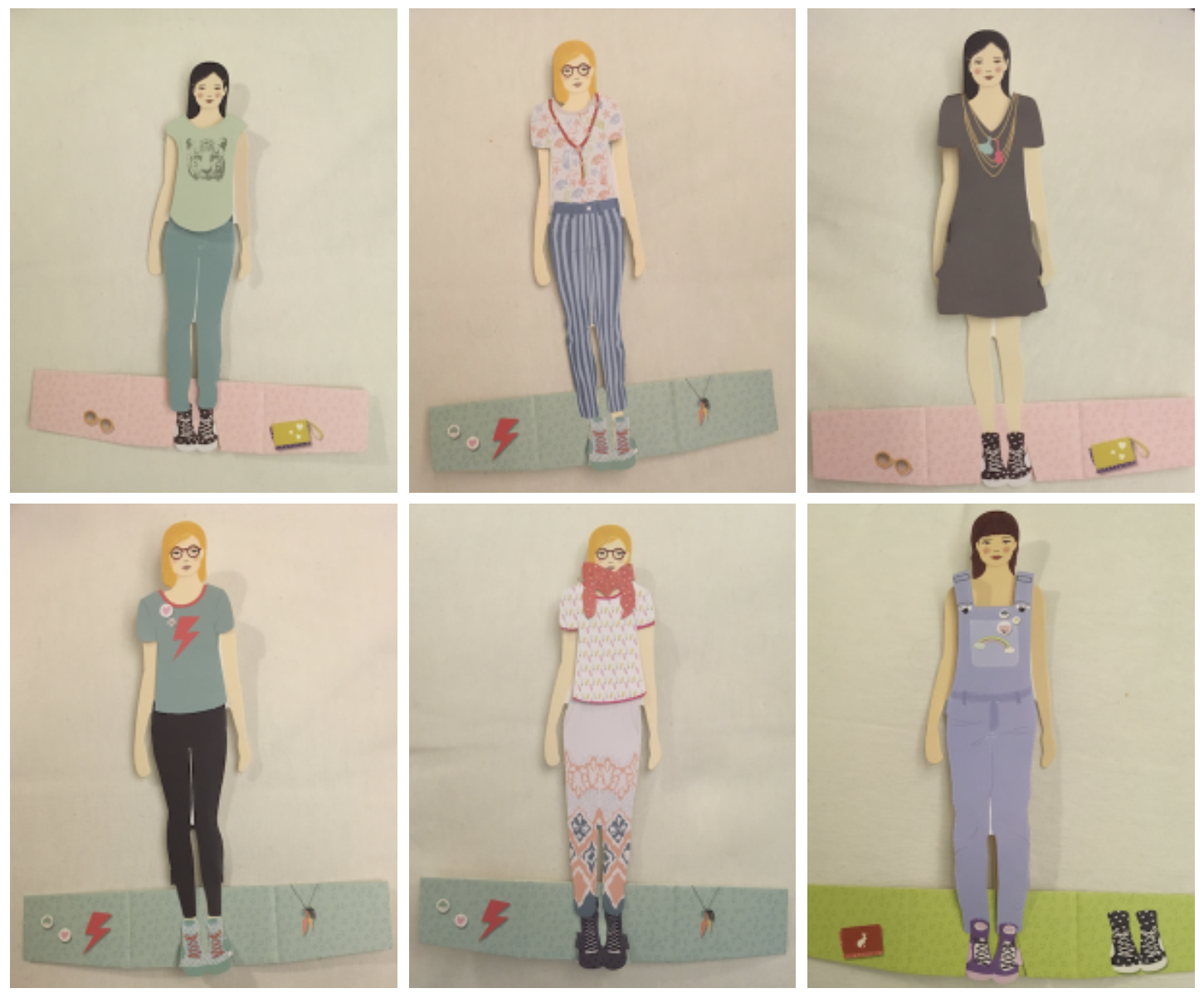
In lessons one & two, we introduced the grammar through brainstorming (mind maps), matching names to cards, memory games, flashcards and so on. We also quickly clarified the form, use and meaning of the present continuous, and activated it using photos from various fashion magazines. The girls each had to choose one outfit they liked and one they didn't, and describe both. In the second half of lesson two, we played a paper-doll game I'd found in my favourite toy shop: Le Grand Dressing (by Djeco). The girls dressed paper dolls in outfits chosen from more than a hundred clothing items, for different occasions — going to the theatre, a birthday party, school, the park — and I photographed each finished creation. At home, they had to describe what the dolls were wearing, as a writing exercise.
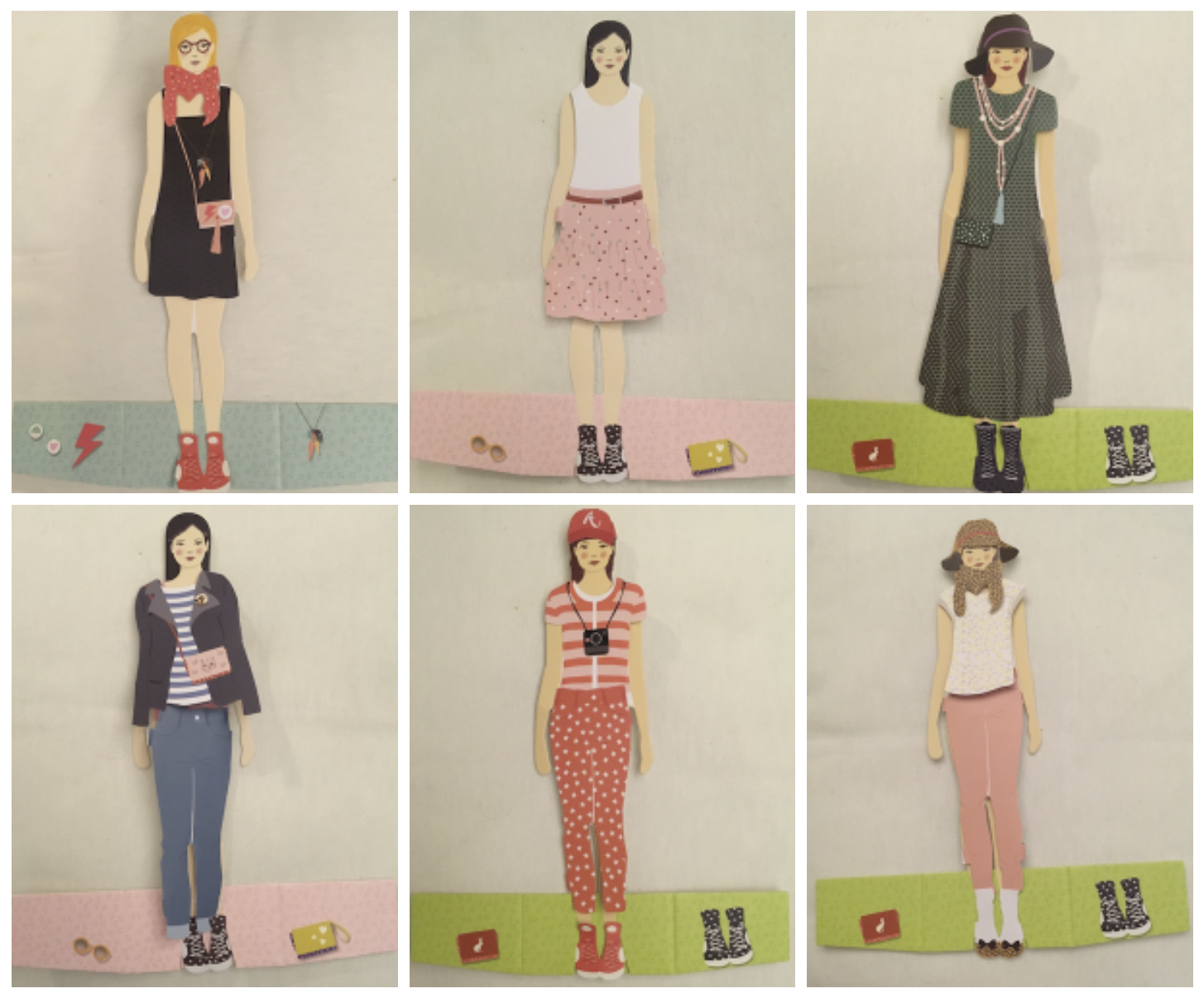
In lesson three, the girls brought a suitcase full of clothes for the occasions listed above. They'd sent me their song choices in advance, one for each outfit. In the lesson, they got dressed, then walked down the catwalk — my living room — while I filmed them. They could watch the recording back and repeat their walk if they wished; we had time for three outfits each. After the catwalk, they posed for the magazine photo shoot in each outfit — I was amazed at how many charming, even cheekily confident, poses these eight- and nine-year-olds came up with. I sent the photos to their parents, who chose five favourites to include in the magazine.
Lesson four was devoted to editing the magazine, still on paper. I'd printed the chosen photos and prepared sheets of paper, colouring materials and a sample page:
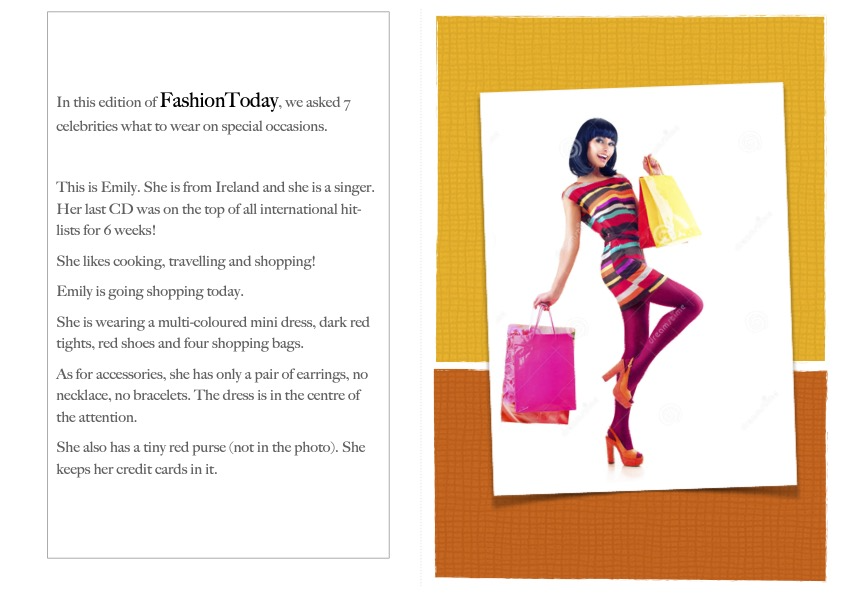
First, I asked the girls to name our magazine, and they settled on Fashion Storm. Next, they designed the cover (we'd agreed on a horizontal A4 layout); I photographed the three designs and sent them to the parents, who picked the winning one as our official cover. The girls then cut out and stuck down their photos (three pages each) and wrote a caption for each, following the sample page — inventing a name, profession and background story for every photo. The final page was set as homework, which they sent to me via WhatsApp.
The final edit was my job: I compiled everything into a single document and added the captions from the earlier paper-doll homework. The finished magazine was sent to parents as a Christmas present, and we printed a copy for ourselves too.
My experience was thoroughly positive — I'd encourage you to try something similar, and let me know how it goes in the comments.
Final notes:
- For privacy reasons, I can't share the girls' photographs here.
- This post still talks about my Tiny Talents activity (a home-nursery), which is no more active. However, I still run project-based courses, or better yet, I always try to include projects in my courses.
You might like these learning resources: