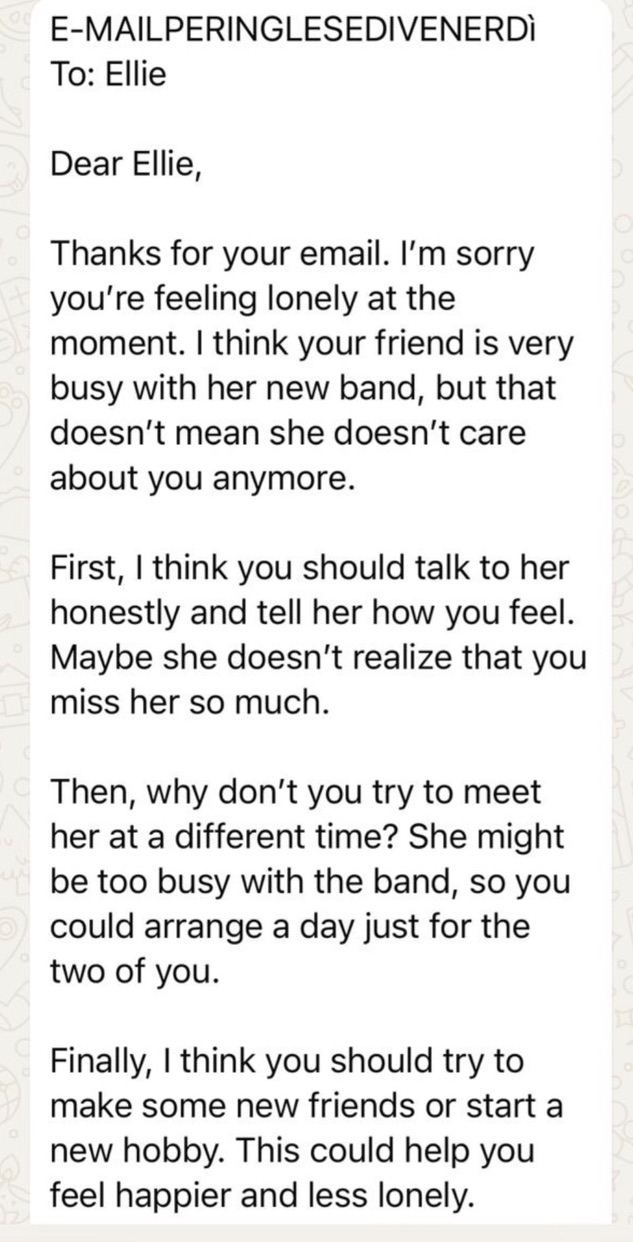
We all know that written homework is written by AI. Let me show you what we deal with on a weekly basis:
Homework task sent to me from home:
Similar task written by the same student in the same period in class (written on and corrected by www.writeandimprove.com):
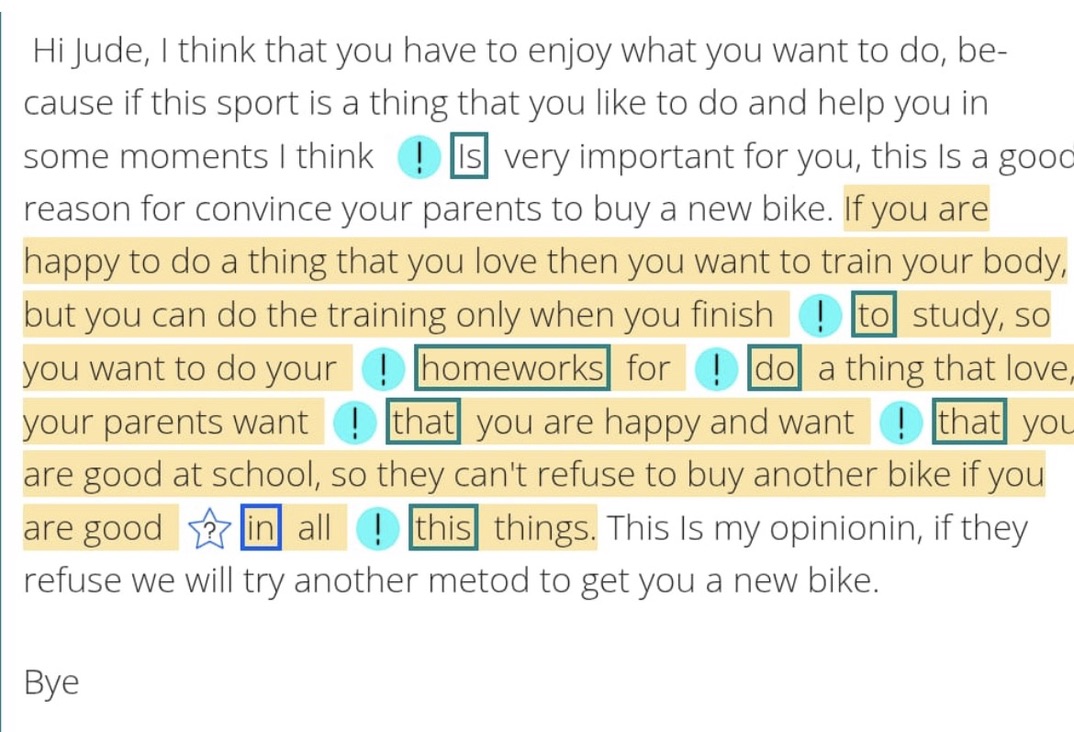
This is the main reason why I prefer to assign listening and reading tasks for homework rather than writing.
Why assign homework at all?
We are rapidly moving from bringing more content into the classroom to not assigning homework at all. Yet look at the problem from a teacher's point of view. While students write (or listen or read), the teacher is just staring at them, inactively. Monitoring is useful during speaking tasks (and even with grammar and vocabulary exercises), whereas receptive tasks cannot be monitored (during a listening, the teacher can't even move).
Running a writing task in class is even harder. Some students write with ease, finish first and expect feedback, while others struggle with the first sentence. Reading and correcting texts takes time and concentration. Early finishers can be given another task while the rest catch up, but the whole process (writing, correction, feedback) usually takes the entire lesson, and the speaking task goes unmonitored if the teacher is busy correcting.
With young learners it gets really nerve-racking: they keep using the teacher as a walking dictionary ("What's the simple past of 'buy'?"), and reading their handwriting is worse than deciphering a doctor's prescription.
A solution could be to have them write on a tablet or smartphone, collect the texts and give proper feedback in the following lesson. My saving grace is Google Docs, where I can highlight and label mistakes so that students notice, recognise and correct them themselves. Once again, this requires charged, working tablets or laptops, internet access for everyone and some basic computer skills.
Platforms and chats for posting homework
Homework has existed since school was invented, and it has never been popular. My primary and middle school kids sit through six hours at school, so if they study two hours in the afternoon, they work more than a full-time employee on 37.5 hours a week. Honestly, the homework assigned is often just what could not be done in class (or, my real nightmare, copying from the book into the notebook and colouring pictures. Seriously?). Homework used to be assigned in class, but with the new platforms (Didup or Classroom, to name just two), teachers post it online. This means teachers began postponing their homework assignments until after school, often while preparing the next lesson. So students might get the surprise at 6 pm that they still have work to do, in some cases for the next day. If they have training or other commitments in the late afternoon, this becomes a problem. Moreover, it keeps kids and teens in continuous tension. This problem led to a very recent debate in Italy: teachers should not send homework to students outside school hours.
Teachers fight back too: they often don't get to the exercises they originally planned to assign for home, so they need to re-evaluate which ones are necessary or useful for the next lesson. Another fair point.
Giving young people too much free time can be dangerous if they only spend it playing on their gadgets. This is every parent's main battle nowadays, and keeping kids away from screens is an expensive initiative. Parents enrol their children in courses (sport, languages, music) to keep them productively busy, otherwise they'll stay on the couch playing or scrolling. We shouldn't forget the most important free-time activity: meeting friends, which is, honestly, very difficult to squeeze into a young learner's life, or leads to the same video-game rodeo at someone's home. Kids don't play in the streets any more. Why not is another interesting question, but not pertinent here.
What could possibly be the solution?
We need to be more efficient in lessons. Better preparation (tailored to each class and its pace), more interaction and more focus on the really important points, rather than just teaching the book, could save a great deal of time and allow teachers to finish all the tasks in the classroom. Homework should then become relaxing or socially meaningful. Connect what your book teaches to real-life experience. Watching your favourite series in the language you are studying is only the first step. Let me propose some ideas to challenge my colleagues, whatever their subject, to rethink what they assign.
Creative homework ideas
- Communication strategies: find examples from everyday life, online or offline, of interrupting, apologising, compromising, communication breakdown (ghosting), explaining something patiently and impolite utterances, and how they could have been phrased instead.
- Maths in real life: when do you need division (e.g. sharing Halloween candies), percentages (e.g. tax calculations, interest rates) or geometry (e.g. the volume of a cylinder when a sibling pours fizzy drinks into different glasses)?
- Geography: if you wanted to plan a trip to Mesopotamia, where would you book your flight?
What countries lie within the old Austrian Empire of 1914?
What languages do you speak? Where do people speak your languages? - History (Egyptian hieroglyphs): write a secret code using your own pictorial symbols.
- History (Romans): find weird facts about the Romans on YouTube. Are they true?
- History (before Columbus): write recipes using only European ingredients.
- History (films): watch any film about a historical figure (The Tudors, Napoleon, etc.) and spot the historical inaccuracies.
- Music: try writing the notes of your favourite song, or find classical melodies hidden in modern songs.
- Finance and civic education: in groups, create your own shop with a name and real products (e.g. crafts, Pinterest is full of tutorials for homemade squishy toys and other gadgets, or your old toys, such as a collection of Kinder Surprise figures or soft toys). Create a class currency and a price list. Advertise your products and set up loyalty programmes and discount policies. Sell, buy and resell. Every month, declare your costs and earnings.
- P.E.: monitor your calorie intake and expenditure for a week.
Try a new sport every week.
In which sports did sportspeople from your country win medals at the Olympic Games?
Prepare a debate on whether football should be banned or made compulsory.
Set a monthly step target and check whether students have achieved it. - Grammar: find spelling or grammar mistakes on menus, official letters, etc.
- Italian (plain language): rephrase official letters into everyday language (any utility provider that sends your family a letter could do with a language expert).
- Italian (reviews): write reviews of restaurants, shops, hotels, gyms, etc. and correct them in class.
Follow-up: pretend you're in charge of their social media. How would you reply? - Or, for a real-life example: in groups, write your own newspaper (one A4 sheet is enough). Decide on the columns, and every team member writes one article based on their research (browsing real-life media products). One team member should be responsible for editing the final "product". In my son's class (fifth year of primary school), the kids came up with ideas such as crosswords and puzzles for the readers and a lottery, and they searched for real events to report on with enthusiasm.
- Chemistry: which chemical substances do you have at home, and in what containers?
- Biology: grow three types of plants (a succulent, a pothos and an orchid) and report to the class every month on how they are doing.
You can also introduce your students to a gardening app, which can keep track of the watering schedule and care plan.
Homework should be useful in everyday life and fit into students' experience outside the classroom. It also makes teachers rethink the aim of their lessons: why do we teach this or that syllabus point? I would seriously talk any teacher out of setting pointless homework for the sake of the coursebook. If it's not useful, leave it out or deal with it in class, for the sake of a potential university.
Prepare your kids for life, not only for tests.